Disbursement Meaning: Definition, Examples, and How It Works in Loans, Banking, and Accounting
Disbursement meaning in one line: money paid out from a fund or account, and also the act of paying it out. A lender releasing a loan, a college applying financial aid to your bill, and a company paying a supplier from its bank balance are all disbursements.
You’ll usually see the word on formal paperwork: loan agreements, award letters, bank statements, closing documents, and accounting records. It looks stiff, but the idea is simple once you know where to look. This guide covers the disbursement meaning, pronunciation, origin, real examples, the difference between disbursement and similar words, and the practical details that matter when your own money is involved.
Quick Answers
- Part of speech: noun (the verb is disburse)
- Pronunciation: dis-BURS-ment
- Basic disbursement meaning: money paid out or released
- Common places you’ll see it: loans, student aid, mortgages, escrow, payroll, insurance claims, government grants
- Not the same as: approval, reimbursement, or an accounting expense
What Does Disbursement Mean?
A disbursement is a payout. The money leaves a specific source, such as a lender’s funds, a company’s bank account, an escrow account, or a government program, and goes to someone else for a defined purpose.
Dictionaries describe the noun in two ways: the act of paying out money, and the money that was paid out. That’s why you can say “the disbursement happened Tuesday” (the act) and “the disbursement was $4,000” (the amount) and be correct both times.
Once you grasp the disbursement meaning, the paperwork gets much easier to read. Here’s a clean way to hold the idea in your head. Money moving in is a receipt, deposit, or incoming payment. Money moving out of a fund for an authorized purpose is a disbursement.
Disbursement Meaning in Simple Words
Picture a purse. Someone opens it and hands money to another person because a rule, contract, or approval says they should. That handoff is the disbursement.
The word focuses on the outgoing movement, not on where the money originally came from. A company can disburse sales revenue, borrowed money, grant money, or funds held for someone else. The source changes. The payout is still a disbursement.
A Quick Example
Suppose a contractor receives $100,000 for a building project and then pays out the following:
- Materials: $35,000
- Labor: $40,000
- Equipment rental: $10,000
- Permits and fees: $5,000
- Other project costs: $4,000
The company’s total disbursements are $94,000. The other $6,000 hasn’t been disbursed. It’s still sitting in the account until the company actually pays it out for something.
Disbursement Meaning in Banking
In banking, a disbursement is money released or paid from an account, loan, or other financial arrangement. You’ll run into it in loan papers, credit agreements, escrow statements, and online banking records.
The most important banking use is the gap between approval and release. A bank might approve a $50,000 loan on Monday, but the borrower still has to sign documents, satisfy conditions, or wait for processing. The loan is approved. It isn’t disbursed until the money is actually released.
What Does Disbursement Mean on a Bank Statement?
If a statement line says “disbursement,” money went out of an account or financial arrangement. That’s all the word tells you. The description beside it explains what the payout was for: a loan release, a supplier payment, a transfer to another account, an escrow payment, or a business expense.
Don’t assume every disbursement is a cost to you. A loan disbursement, for example, puts money in your hands. From the lender’s side it’s an outgoing disbursement, and from yours it’s incoming loan funds. The same transaction can look opposite depending on whose books you’re reading.
Loan Disbursement: What Happens After Approval
When people search for disbursement meaning, loans are usually why. A loan has a clear sequence:
Application → Approval → Conditions met → Disbursement → Repayment
The loan disbursement is the point where the lender releases the funds. Everything before it is preparation. Everything after it is the borrower paying the money back.
Where Does the Money Go?
Not every loan sends the full amount to the borrower. Depending on the loan, funds can go to:
- the borrower’s bank account
- a home seller, through the closing process
- a school
- a contractor
- another lender, if the loan pays off an existing debt
So when a notice says “your loan was disbursed,” it doesn’t always mean the money landed in your checking account. It means the lender released it to the proper recipient or recipients.
Full vs. Partial Loan Disbursement
Some loans pay out in one lump sum. Others release money in stages. A construction loan is the classic example: the lender releases funds as work reaches agreed milestones, often called draws. Picture a builder waiting for the foundation inspection to pass before the next draw arrives. Until then, the money stays with the lender, and that’s by design.
A staged loan might look like this:
- First release: $20,000 when work starts
- Second release: $15,000 after framing is complete
- Final release: $15,000 after the final inspection
- Total disbursed: $50,000
Mortgage Loans and the Disbursement Date
In a home purchase, the Closing Disclosure includes a line for the disbursement date, and federal mortgage rules under Regulation Z use that term. It points to the date loan funds are expected to be paid out. On refinances of a primary home, lenders generally hold the funds until the borrower’s right-to-cancel window has passed, which is why a refinance can close on one day and disburse a few days later.
What Does “Loan Has Been Disbursed” Mean?
It means the lender has released the money. Three statuses get mixed up all the time:
- Approved: the lender agreed to lend under certain terms.
- Disbursed: the lender released the funds.
- Repayment: the borrower starts paying the loan back.
Always look for the disbursement date. It’s the one that tells you when money actually moves.
Disbursement Meaning for Student Aid
Many students meet this word for the first time on a financial aid notice. The school receives the aid, then applies it in a set order.
With federal student aid, the school usually applies the money to tuition, fees, and other school charges first. If there’s money left over, the school pays that balance to you. Federal rules generally require schools to pay a credit balance within 14 days of the date it appears on your account, unless you’ve authorized the school to hold it for future charges.
A few practical points that save people stress:
- Aid is usually disbursed once per term or payment period, so a fall disbursement and a spring disbursement are normal.
- Disbursement dates vary by school and by aid type, so grants, federal loans, and private loans may not arrive on the same day.
- Federal loans generally require steps like a Master Promissory Note and entrance counseling before funds can be released for first-time borrowers.
- Federal loan borrowers can typically cancel or return all or part of a disbursement within a limited window, and returning money within 120 days generally means you don’t pay interest or fees on the returned amount.
Here’s the situation that confuses people most. A student waits at the bursar’s office in mid-September, sure that a refund check is missing. The aid hasn’t been disbursed yet, or it has been, but the school applied it to tuition and housing first. Nothing went wrong. The paperwork just uses the word “disbursement” for a step that feels invisible from the student’s side. Your school’s financial aid office can tell you the exact schedule, and that office is the right source because policies differ.
If you want to word an email to that office precisely, it helps to know the difference between asking someone to clarify vs verify a date. You’re asking them to confirm the disbursement date, not to explain what the word means.
Disbursement Meaning in Accounting
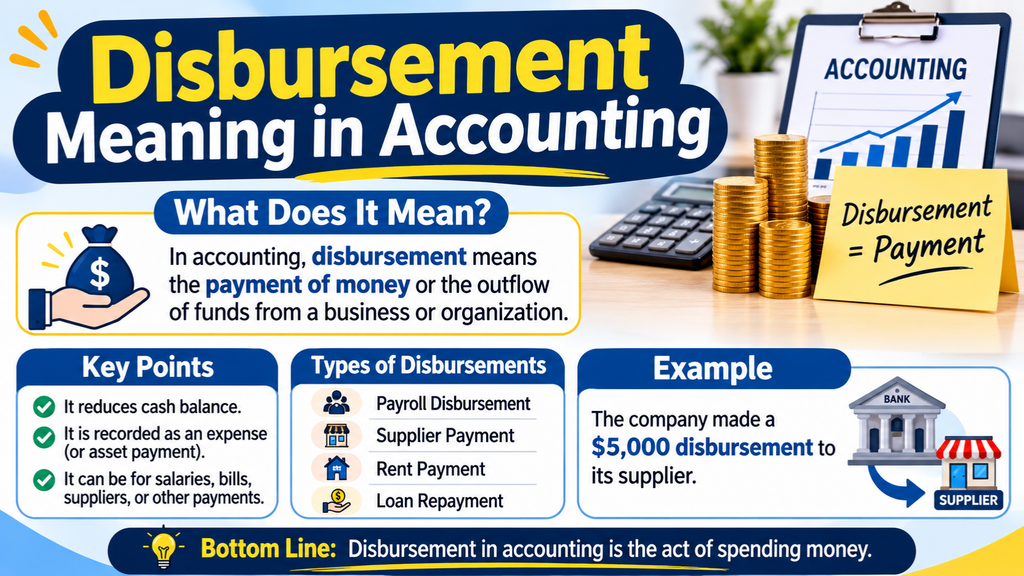
In accounting, a disbursement is any payment of cash or funds out of a business. The goal of tracking it is simple: know how much went out, when, to whom, why, and from which account.
A business typically records this in a cash disbursements journal, a running record of outgoing payments organized by date, payee, amount, and purpose. At month-end, a bookkeeper matches each disbursement to an invoice, receipt, or voucher. A payout with no paper trail is the first thing an auditor questions.
Common Business Disbursements
- Payroll
- Rent and utilities
- Supplier invoices and inventory
- Taxes
- Insurance premiums
- Professional services
- Equipment
- Travel
- Loan payments
- Contractor payments
A Simple Journal Entry
Say a business pays $2,000 in rent from its checking account. The accounting entry looks like this:
Debit: Rent Expense $2,000
Credit: Cash $2,000
The credit to cash is the disbursement. The debit records what the money was spent on.
Is a Disbursement Always an Expense?
No. This trips up a lot of beginners.
A disbursement is cash or funds going out. An expense is a cost recognized under accounting rules. They overlap often, but not always. When a company buys a delivery van, cash leaves the business right away, yet the van is usually recorded as an asset, not as an ordinary operating expense. When a company repays the principal on a loan, cash leaves the business, but that repayment reduces a liability instead of creating a new expense.
So the quickest test of disbursement meaning is this: if you’re asking “did money leave?” the answer points to a disbursement. If you’re asking “what did it cost the business this period?” you’re asking about an expense.
Petty Cash and Vouchers
Small businesses often keep a petty cash box for minor costs such as stamps, coffee supplies, or a courier fee. Each withdrawal is a petty cash disbursement, normally backed by a small slip or voucher that shows the date, amount, and reason. When the box runs low, the bookkeeper tallies the slips and replenishes it.
If you’re setting up good habits, keep a simple log of every payout. Building a clean log is worth the five minutes, and if “log” and “lag” ever blur together in your writing, our guide on lag vs log sorts them out fast.
Disbursement Meaning in Legal, Insurance, and Government Settings
The word travels well beyond banks. In each setting below, someone in the middle controls money and releases it under rules.
Escrow. An escrow account holds money for a specific purpose and releases it when conditions are met. A mortgage servicer, for instance, may collect part of your monthly payment into escrow and later disburse it to pay property taxes or homeowners insurance.
Estates. After someone dies, the executor or personal representative pays debts, taxes, and expenses, then distributes what remains to heirs. Each payout from the estate account is a disbursement, and the final handing-over to heirs is usually called a distribution.
Legal settlements. When a lawsuit settles, the money is commonly deposited into an attorney’s trust account first. The attorney then disburses it to the client, the firm, and any lienholders or other parties owed, according to the settlement terms and the rules governing client funds.
Insurance. When a claim is approved, the insurer pays it out. That payment, whether sent to you or to a repair shop, is a claim disbursement.
Government programs. Agencies disburse money for grants, contracts, benefits, and approved programs, and the Treasury Department handles most federal payments. In this setting the word stresses the formal release of public funds rather than an ordinary purchase.
Types of Disbursements
The disbursement meaning stays the same across types; they’re grouped by how the money moves or what it’s for.
Cash disbursements. Money paid out in cash or from a cash account. Because physical cash is easy to lose track of, businesses document it carefully.
Check disbursements. A business writes a check to a supplier, contractor, or other payee. The check is the payment method. The disbursement is the outgoing transaction.
Electronic disbursements. Bank transfers, ACH payments, wire transfers, and online bill payments all count. Processing time depends on the method and the banks involved.
Payroll disbursements. Wages or salaries paid to employees, usually on a repeating schedule.
Loan disbursements. A lender releases borrowed funds to a borrower or another approved recipient.
Escrow disbursements. Money held in escrow is released to cover taxes, insurance, or other authorized obligations.
Grant and aid disbursements. A school, agency, or foundation releases approved funds for a defined purpose.
How a Disbursement Works, Step by Step
The details differ by organization, but the pattern is steady: money is available, a payout is authorized, the payment is processed, and the transaction is recorded.
A Business Paying a Supplier
- The business receives an invoice.
- Someone confirms the goods or services were delivered.
- A manager approves the invoice.
- The payment is scheduled.
- The money is sent by check or electronic transfer.
- The disbursement is recorded in the books.
A Lender Releasing a Loan
- The borrower applies.
- The lender reviews the application and approves it.
- The borrower completes the required documents and conditions.
- The lender releases the funds on the disbursement date.
- The loan balance begins to accrue, and repayment follows its schedule.
Notice that steps 1 through 3 are everything that happens before the disbursement. That’s why people get frustrated: they’ve done all the work, but the part they care about hasn’t happened yet.
Disbursement vs. Payment vs. Reimbursement vs. Distribution
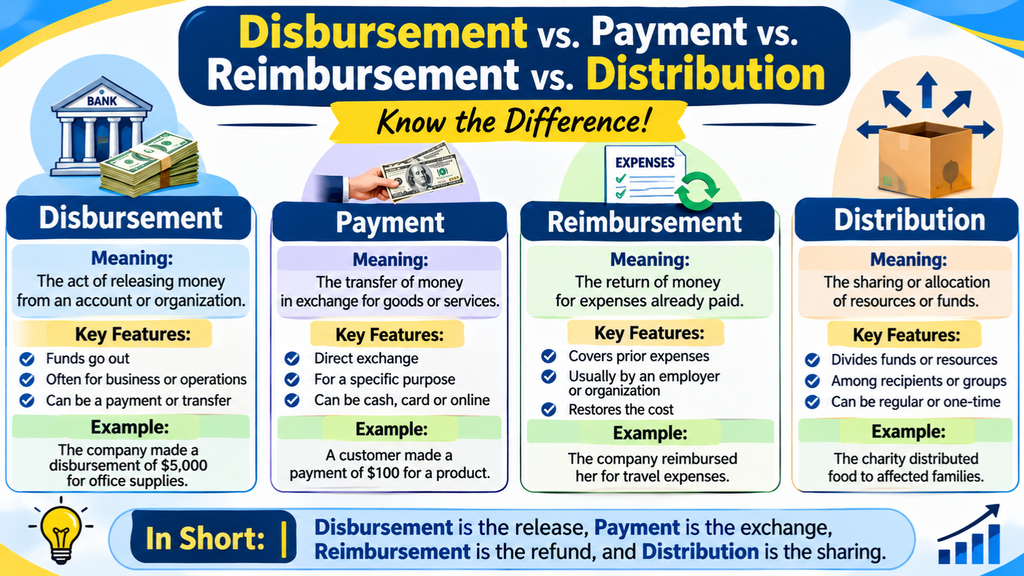
These words overlap, which is exactly why people mix them up. Here’s how they line up:
| Term | What it means | Example |
| Disbursement | Money paid out from a fund or account, usually in a formal context | A lender releases loan funds |
| Payment | Any transfer of money to settle a bill, debt, or purchase | Paying your phone bill |
| Reimbursement | Paying someone back for money they already spent | An employer repays an employee’s travel costs |
| Distribution | Allocating money or assets among recipients | An estate dividing assets among heirs |
| Receipt | Money received | A shop collects $200 from a customer |
The verdict: every disbursement is a kind of payment, but not every payment is a disbursement. If money is leaving a specific fund or controlled account under a formal process, use disbursement. If someone is being paid back for something they covered, use reimbursement. If a friend hands you the $20 they owe you, just say they paid you.
Disbursement vs. Reimbursement in Practice
Consider an employee who buys $250 of approved supplies with a personal card. When the company later repays $250, that’s a reimbursement. If the company had instead paid the supplier directly, it would be a disbursement or a payment to the vendor, and the employee wouldn’t be reimbursed for anything.
The two words even share a root, which helps them stick: both trace back to the idea of a purse.
Disbursement vs. Distribution
Disbursement stresses the act of money going out. Distribution stresses how money or assets are divided among several recipients. An estate might distribute assets among three beneficiaries, and each transfer involves a disbursement of funds. Same event, different emphasis.
Disbursement vs. Expenditure, Remittance, and Payout
- Expenditure focuses on spending and cost. It’s closer to the accounting idea of an expense.
- Remittance usually means sending money to someone, often a payment that travels from one place to another, such as a worker sending money home.
- Payout is the everyday, casual cousin. It works for lottery winnings, insurance claims, and gig platforms, and it’s less formal than disbursement.
Word Forms: Disburse, Disbursed, Disbursing, Disbursal
- Disburse (verb): to pay out money. The lender will disburse the funds on Friday.
- Disbursed (past tense and past participle): paid out or released. The loan was disbursed yesterday.
- Disbursing (present participle): in the act of paying out. The agency is disbursing grant money this month.
- Disbursement (noun): the act of paying out, or the amount paid. The borrower received the disbursement.
- Disbursal (noun, less common): another word for disbursement. The disbursal of funds was delayed.
Spelling: Disbursement, Disbursment, or Dispersement?
The correct spelling is disbursement, with an e before -ment.
Two mistakes show up constantly:
- Disbursment (missing the second e). Remember the verb disburse, then add -ment.
- Dispersement (swapping s for p). This one comes from confusing disburse with disperse.
The two verbs mean different things:
- To disperse is to scatter or spread out. A crowd disperses after a concert.
- To disburse is to pay out money. A bank disburses a loan.
So “disperse the funds” is wrong when you mean “pay out the funds,” and “dispersement date” should be “disbursement date.” If you work with American and British spelling in your writing, the same detail-focused habit helps with pairs like prioritize vs prioritise. For disbursement, though, there’s only one standard spelling in both US and UK English.
How to Pronounce Disbursement
Say it dis-BURS-ment. The stress falls on the second syllable, just like the verb disburse (dis-BURS). The American pronunciation is commonly written /dɪsˈbɝːsmənt/. If you’ve only seen the word in writing, split it into three chunks: dis, burse, ment. It’s burse like nurse, not bus.
Disbursement Meaning and Word Origin
The verb disburse entered English in the 1500s from Old French desbourser. It’s built from a prefix meaning “away” plus bourse, meaning purse. The literal picture is taking money out of a purse and handing it over.
That same purse root shows up in other money words you already know:
- Reimburse: to put money back into someone’s purse
- Bursar: the school official who manages funds and student accounts
- Bourse: a French word for a stock exchange
Over time, disbursement settled into formal use. People say “I paid the bill” at a diner and “the lender disbursed the loan” in a contract, and both are natural in their settings.
Real-Life Examples of Disbursement Meaning
Business
A company pays a supplier $8,500 for inventory. The outgoing payment is recorded as a disbursement.
Payroll
A company transfers wages to employees every two weeks. Each pay run is a payroll disbursement.
Loan
A bank approves a $15,000 personal loan and deposits the funds into the borrower’s account. The $15,000 release is the loan disbursement.
Scholarship and Grant
A school releases approved scholarship funds. The money may first cover tuition and fees, with any remainder going to the student.
Escrow
A mortgage servicer pays a property tax bill from the borrower’s escrow account. That payout is an escrow disbursement.
Government
A state agency pays out an approved program grant to a local organization in installments.
A Case Study: Two Disbursements, Two Different Experiences
Maya, a first-year student. Her award letter lists $6,000 in federal loans for the year. In August she assumes she’ll have cash for a laptop and textbooks. In September she logs into her student account and finds the loan has been disbursed in two halves, one per semester, and the first half has already gone to tuition. A small credit balance remains, and the school pays it to her within the required window. She’d mistaken approval for cash in hand. Now she knows to read the disbursement schedule before making plans.
Dan, a small contractor. He wins a $60,000 renovation job and gets a $20,000 deposit. He pays $9,000 for lumber, $6,500 to two subcontractors, and $1,200 for permits. His disbursements so far total $16,700, and $3,300 of the deposit is still in the account. When the client’s second payment arrives, he repeats the cycle. Every payout gets a note in his books, which makes tax season far less painful.
The lesson in both stories is the same. The disbursement meaning here is clear: the money’s arrival and its departure are separate events, and disbursement is the departure.
Why Approval and Disbursement Aren’t the Same Thing
Suppose you receive a message saying your loan has been approved for $25,000. That doesn’t automatically mean you can spend $25,000 today. The lender may still need signed documents, identity checks, collateral details, account information, or closing steps.
Knowing the disbursement meaning isn’t just vocabulary practice. The gap affects when you can pay a contractor, cover a deposit, or register for classes. If a timeline matters to you, ask the lender or school two direct questions: What is the disbursement date? and Where will the money be sent?
Common Mistakes to Avoid
Treating approval as disbursement. Approved means the answer was yes. Disbursed means the money moved.
Calling every payout an expense. As the accounting section showed, buying equipment or repaying loan principal sends money out without being an ordinary expense.
Using the word for casual spending. You’d normally say you bought lunch, not that you made a disbursement at a cafe. The disbursement meaning fits formal, financial, or business writing.
Confusing disbursement with reimbursement. One is the payout. The other is paying someone back.
Misspelling it. Disbursment and dispersement both look wrong to a careful reader, and spell-checkers don’t always catch the second one because dispersement resembles a real word.
Ignoring the date. The disbursement date drives your cash flow. Check it early. If a penalty or late fee is attached to a deadline, our breakdown of penality vs penalty will keep your spelling right when you write about it.
Practical Tips for Borrowers, Students, and Small Business Owners
For borrowers
- Ask for the disbursement date in writing, not just the approval date.
- Confirm whether the money goes to you or to a third party.
- Be wary of anyone who asks you to pay a fee before they will “release” a loan. A legitimate lender takes its costs out of the loan or discloses them upfront.
For students
- Read your school’s disbursement calendar before you rely on a refund.
- Keep your bank details and mailing address current so a credit balance doesn’t get stuck.
- Don’t assume all aid types arrive on the same day.
For small business owners
- Record every disbursement the day it happens, with a receipt or voucher.
- Reconcile your books to your bank statement monthly.
- Separate business and personal payouts so your records stay clean.
- If you need to estimate whether a purchase is worth the outflow, it helps to know how people reckon vs value a cost when they write about it.
Disbursement Synonyms and Antonyms
Close synonyms: payment, payout, outlay, expenditure, release of funds, settlement payment
Opposites: receipt, deposit, collection, incoming payment
For disbursement meaning, the closest everyday synonym is payment, but the swap isn’t perfect. Calling a loan disbursement an “expense” would change the meaning, and calling reimbursement a disbursement would miss the fact that someone is being paid back.
Disbursement in a Sentence
- The bank processed the loan disbursement after it received the signed documents.
- Her first scholarship disbursement was delayed because the school needed one more form.
- The company recorded the supplier payment as a disbursement.
- The lender disbursed the funds directly to the contractor.
- The project received its first disbursement in June.
- The escrow account made a disbursement for property taxes.
- Every disbursement must be approved by two managers.
- The final disbursement covered the remaining construction costs.
- The executor itemized each disbursement from the estate.
- Check the disbursement date before you schedule the move-in.
Frequently Asked Questions About Disbursement
What is the disbursement meaning in simple terms?
Disbursement means money paid out or released. It’s the formal word for a payout from a fund, account, or organization, and it also names the amount that was paid.
What is an example of a disbursement?
A bank releasing a $10,000 loan to a borrower is a disbursement. So is a company paying a supplier from its bank account or a school applying financial aid to a student’s bill.
What does loan disbursement mean?
Loan disbursement means the lender has released the approved funds to the borrower or to another authorized recipient, such as a seller, school, or contractor.
What is the disbursement meaning in banking?
In banking, disbursement refers to money being paid out or released from an account or financial arrangement. Loan proceeds are the most common example.
Does disbursement mean payment?
Often, yes. A disbursement is a type of payment, usually in a formal or institutional setting. “Payment” is the broader everyday word.
What does “funds disbursed” mean?
It means the money has already been released. Depending on the transaction, it may have gone straight to you or to another approved party.
What does “funds will be disbursed” mean?
It means the money hasn’t been released yet but is expected to be, usually after required steps are finished. It’s a promise about timing, not proof the money is available.
Is disbursement money coming in or going out?
Going out, from the point of view of the fund, account, or organization making the payout. For the person receiving it, the same money is incoming.
Is a disbursement an expense?
Not necessarily. A disbursement describes money leaving. An expense is an accounting cost. Equipment purchases and loan principal repayments are disbursements that aren’t ordinary expenses.
What is the difference between disbursement and reimbursement?
A disbursement is money paid out. A reimbursement is money paid back to someone who already covered a cost.
What is a disbursement date?
It’s the date funds are released or expected to be released. On a loan, mortgage, or student aid notice, it’s the date that tells you when money actually moves.
What is a cash disbursement?
A cash disbursement is any outgoing payment of cash or cash-equivalent funds from a business, such as a check, a bank transfer, or physical cash. Businesses track these in a cash disbursements journal.
Is it dispersement or disbursement?
The correct term for paying out money is disbursement. Dispersement is a misspelling in this context. Disperse means to scatter, not to pay.
What is the verb form of disbursement?
The verb is disburse. You disburse funds, and the result is a disbursement.
Can a disbursement happen in more than one payment?
Yes. Construction loans, student aid, grants, and many business contracts release money in stages, and each release is a separate disbursement.
What happens if I don’t receive my disbursement?
First confirm the disbursement date and the destination. Then check your account and contact the lender, school, or paying organization. Delays often come from missing documents, wrong bank details, or processing time.
Final Thoughts
Disbursement means money paid out or released, usually through a formal financial process. In loans, it’s the moment the lender releases the funds. In student aid, it’s when approved money is applied to your school account. In accounting, it’s cash leaving the business. In estates, escrow, and settlements, it’s money handed over by the party holding it for others.
Remember the short version of the disbursement meaning: disbursement is money going out, and the date it happens is the date that matters. Approval is a promise, reimbursement is repayment, and an expense is an accounting cost. Keep those four ideas separate and you’ll read any financial document with more confidence.
Want more plain-English breakdowns of confusing words? Browse the Spelling guides and Vs comparisons on ClearPenPress. And if a deadline is stated as “within 14 days,” it’s worth knowing the difference between within vs withing before you put it in writing.